


Biohaven Oral Presentation at ASN Kidney Week 2026 Spotlights BHV-1420, a Novel TRAP Degrader Designed to Selectively Remove the Autoantibodies that Drive Membranous Nephropathy
One year after
- BHV-1420 is an investigational TRAP™ extracellular protein degrader. It is designed to bind anti-PLA2R autoantibodies, the main driver of disease in most patients with membranous nephropathy, directing them to the liver for degradation without immunosuppression.
- In a competitive clinical diagnostic ELISA, BHV-1420 brought 88% of anti-PLA2R-positive patient samples (n=59) below the clinical threshold for positivity.
- In a mouse model, a single subcutaneous dose of BHV-1420 rapidly cleared circulating anti-PLA2R antibody in a dose-dependent manner, achieving >90% depletion within two hours that was sustained over the 72-hour test period.
- BHV-1420 joins BHV-1400 in IgA nephropathy as the second program in
Biohaven's TRAP nephrology franchise. Both are built on extracellular protein degrader technology exclusively licensed fromYale University .
The presentation continues
- 2024: BHV-1400, the Company's TRAP degrader for IgA nephropathy (IgAN), made its Kidney Week debut with preclinical data.
- 2025: With BHV-1400 in clinical studies,
Biohaven's TRAP degrader approach in IgAN was highlighted in the opening plenary state-of-the-art lecture. - 2026: BHV-1420 takes the podium as the second TRAP degrader in
Biohaven's nephrology franchise.
"Last year, our TRAP degrader approach to IgA nephropathy was highlighted in the opening plenary at Kidney Week. This year we are back at ASN with BHV-1420, the second TRAP degrader in our nephrology franchise," said
A Precision Approach to an Antibody-Driven Disease
MN is one of the clearest examples in nephrology of a disease driven by a measurable autoantibody. In most patients with primary MN, autoantibodies attack PLA2R, a protein on podocytes, the specialized cells that maintain the kidney's filtration barrier. This damages the barrier causing heavy protein loss in the urine but also causes an inflammatory immune cascade leading to progressive kidney disease. Anti-PLA2R levels are measured in routine practice and track with disease activity. Yet, current treatment relies on broad immunosuppression with rituximab, cyclophosphamide, calcineurin inhibitors and corticosteroids. Even so, many patients do not achieve or stay in long-term remission which are characterized by the return of the anti-PLA2R autoantibodies.
BHV-1420 is a bispecific molecule designed to work differently. Instead of suppressing the immune cells that make antibodies, it captures and removes the harmful autoantibody itself. One end of the molecule binds anti-PLA2R autoantibodies and the other end binds the asialoglycoprotein receptor (ASGPR), which liver cells use to clear senescent proteins from the blood. The liver cell then takes in the complex and breaks down the autoantibody via the lysosome(Figure 1).
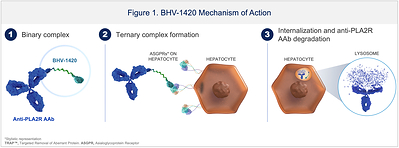
Figure 1. BHV-1420 mechanism of action. (1) BHV-1420 binds a circulating anti-PLA2R autoantibody (AAb). (2) The complex engages the asialoglycoprotein receptor (ASGPR) on hepatocytes, forming a ternary complex. (3) The autoantibody is internalized and degraded in the lysosome. *Stylistic representation. TRAP, Targeted Removal of Aberrant Protein.
Key Findings Presented at Kidney Week 2026
- MECHANISM CONFIRMED IN THE LAB: BHV-1420 formed the ternary complex (antibody, degrader and ASGPR) needed for degradation and drove ASGPR-dependent uptake of anti-PLA2R antibody into cells.
- BROAD COVERAGE OF PATIENT AUTOANTIBODIES: Patient samples were pre-mixed with BHV-1420 before running a clinical diagnostic anti-PLA2R ELISA. BHV-1420 brought 88% of anti-PLA2R-positive samples tested (n=59) below the threshold for positivity. This indicates it recognizes most of the autoantibodies found in patients (Figure 2). In clinical practice, patients achieve "immunologic remission" of disease when their autoantibodies fall below this threshold of positivity.
- RAPID CLEARANCE IN MICE: Mice received anti-PLA2R antibody at levels similar to those seen in patients, followed by subcutaneous BHV-1420. Circulating anti-PLA2R antibodies fell rapidly and in a dose-dependent manner. At the highest dose (4.8 mg/kg), a single dose of subcutaneous BHV-1420 achieved >90% depletion of circulating anti-PLA2R antibodies within two hours and sustained over the 72-hour study period (Figure 3).
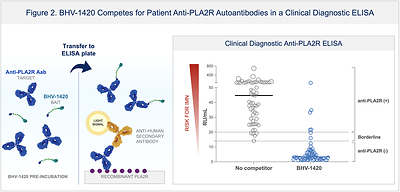
Figure 2. BHV-1420 competes for patient anti-PLA2R autoantibodies in a clinical diagnostic ELISA. Patient samples were pre-incubated with or without BHV-1420 and transferred to plates coated with recombinant PLA2R; bound autoantibody was detected with an anti-human secondary antibody. BHV-1420 reduced 88% of anti-PLA2R-positive IMN samples tested (n=59) below the clinical diagnostic threshold for positivity. IMN, idiopathic membranous nephropathy; RU, relative units.
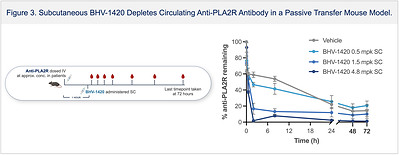
Figure 3. Subcutaneous BHV-1420 depletes circulating anti-PLA2R antibody in a passive transfer mouse model. Anti-PLA2R antibody was administered intravenously at approximately patient-level concentrations, followed one hour later by subcutaneous BHV-1420 (0.5, 1.5 or 4.8 mg/kg) or vehicle; blood was sampled through 72 hours. Line graphs show relevant amounts of anti-PLA2R antibody remaining over a 72-hour study period following subcutaneous BHV-1420 dosing. IV, intravenous; mpk, mg/kg; SC, subcutaneous.
"BHV-1420 shows how modular the TRAP platform is," said
Built on a Clinically Validated Platform from Yale
BHV-1420 is built on
- HOW TRAP DEGRADERS WORK: All TRAP degraders use the same ASGPR clearance route. Each one's target-binding end is tailored to a single disease-causing protein and designed to spare healthy antibodies.
- CLINICAL VALIDATION: The lead MoDE™ degrader, BHV-1300, is in a Phase 3 trial in Graves' disease. The lead TRAP degrader, BHV-1400 has produced selective reductions of Gd-IgA1 in patients with IgAN.
Presentation Details
|
Title |
Preclinical Characterization of BHV-1420: A Novel TRAP™ Degrader of PLA2R |
|
Presenter |
Edward deRamon, Ph.D., Principal Investigator, Medicinal Chemistry, |
|
Session |
Preclinical Characterization of BHV-1420: A Novel TRAP Degrader of |
|
Date and time |
|
|
Location |
|
About Membranous Nephropathy
Membranous nephropathy (MN) is an autoimmune kidney disease and a leading cause of nephrotic syndrome in adults, with an estimated incidence of approximately 1.2 per 100,000 people per year. In 70% to 80% of patients with primary MN, autoantibodies against PLA2R drive the disease. Patients develop protein loss in the urine, swelling, high cholesterol, low blood protein and fatigue. International guidelines use anti-PLA2R autoantibody testing for diagnosis and monitoring. Despite treatment, 30% to 40% of patients do not stay in long-term remission and are at risk of kidney failure. MN can also return after kidney transplantation.
About BHV-1420
BHV-1420 is an investigational TRAP degrader designed to selectively bind circulating anti-PLA2R autoantibodies and direct them to liver cells for degradation. Because it is designed to remove the harmful autoantibody rather than suppress the immune system, BHV-1420 is being developed as a potential first-in-class precision therapy for PLA2R-associated MN. BHV-1420 is in preclinical development. It has not been approved by the
About BHV-1400
BHV-1400 is
About Biohaven
Biohaven Ltd. is a clinical-stage biopharmaceutical company headquartered in New Haven, Connecticut. It discovers and develops therapies in immunology, obesity, neuroscience and oncology. Its proprietary platforms include MoDE and TRAP extracellular protein degraders for immune-mediated diseases, next-generation ADC platform for oncology, Kv7 ion channel activators for epilepsy, and myostatin-activin pathway inhibitors for neuromuscular and metabolic diseases. For more information, visit www.biohaven.com.
Forward-Looking Statements
This news release contains forward-looking statements within the meaning of the Private Securities Litigation Reform Act of 1995, including statements about the potential of BHV-1420 and other TRAP and MoDE degraders, the future development of Biohaven's degrader programs and the potential for strategic partnerships. Words such as "designed to," "potential," "believe," "may," "will" and "continue" identify forward-looking statements. These statements are not guarantees of future performance and involve risks and uncertainties, including whether preclinical results will be reproduced in humans, whether BHV-1420 advances into clinical development, the outcomes of clinical trials, decisions by the U.S. Food and Drug Administration and other regulators, the availability of funding and partners, and the other risks described in Biohaven's filings with the U.S. Securities and Exchange Commission, including the sections titled "Risk Factors." Forward-looking statements speak only as of the date of this release, and Biohaven undertakes no obligation to update them except as required by law.
MoDE and TRAP are trademarks of Biohaven Therapeutics Ltd.
Investor Contact
Jennifer Porcelli, Vice President, Investor Relations
jennifer.porcelli@biohavenpharma.com | +1 (201) 248-0741
Media Contact
Mike Beyer, Sam Brown Inc.
mikebeyer@sambrown.com | +1 (312) 961-2502

 View original content to download multimedia:https://www.prnewswire.com/news-releases/biohaven-oral-presentation-at-asn-kidney-week-2026-spotlights-bhv-1420-a-novel-trap-degrader-designed-to-selectively-remove-the-autoantibodies-that-drive-membranous-nephropathy-302918924.html
SOURCE Biohaven Ltd.
BIOHAVEN (BHVN)
| Volume | ||
| Market Cap | ||
| 52 Week High | ||
| 52 Week Low |
Minimum 15 minutes delayed. Source: LSEG